September 26, 2026
Unix Timestamp vs. ISO 8601: Which Should Your API Use?
A Unix timestamp is a single integer — seconds (or milliseconds) since January 1, 1970 UTC — with no timezone ambiguity because it's always UTC by definition. ISO 8601 (e.g. 2026-09-26T14:30:00Z) is a human-readable string that also unambiguously encodes timezone, but takes more bytes and needs parsing before you can do date math on it. Most APIs are better served by ISO 8601 for anything a human will read, and Unix timestamps for anything purely computational.
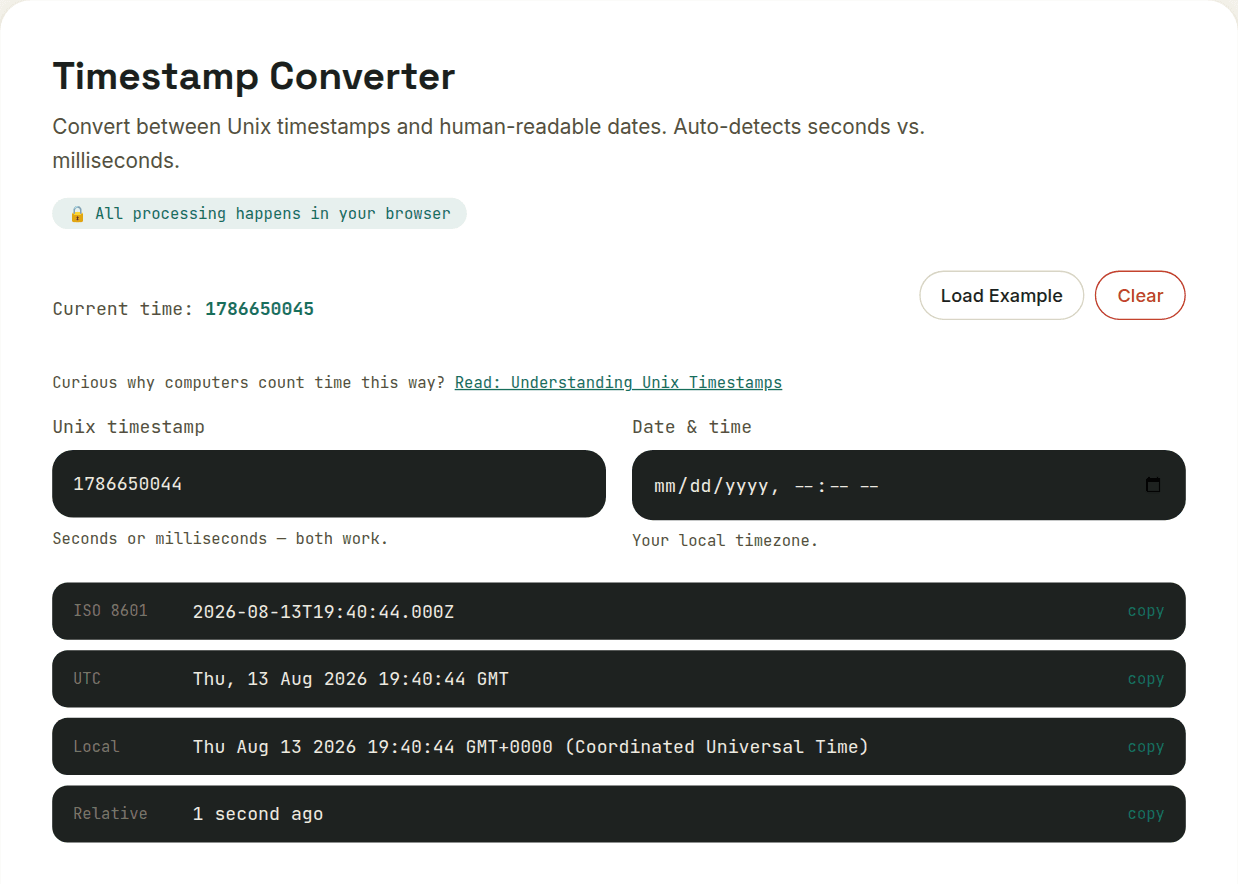
Unix timestamp: compact, unambiguous, unreadable
- Pro: a plain number — trivial to compare, sort, and do arithmetic on (add 3600 for "one hour later")
- Pro: always UTC, so there's no timezone bug waiting to happen in how it's stored
- Con: completely unreadable without conversion — 1758895800 tells a human nothing
- Con: the seconds-vs-milliseconds ambiguity is a real, recurring source of bugs when passing timestamps between systems that assume different units
ISO 8601: readable, self-describing, verbose
- Pro: human-readable at a glance in logs, API responses, and debugging output
- Pro: the format itself specifies precision and timezone (the trailing Z means UTC; an offset like +02:00 is also valid) — no separate field needed to know which
- Con: more bytes than a numeric timestamp, and string comparison for sorting only works correctly if every value uses the exact same format and precision
- Con: needs to be parsed into a date object before you can do arithmetic on it
The practical rule
Use ISO 8601 in API responses, logs, and anything a person or another team will read directly — the self-describing timezone alone prevents a whole category of "was this UTC or local time" bugs. Use Unix timestamps internally for storage and computation where you control both ends and just need fast comparisons and arithmetic. Many systems do both: store as Unix timestamp internally, serialize as ISO 8601 at the API boundary.
Want to try this yourself?
Open Timestamp Converter →