July 13, 2026
SQL Formatting: Why Readable Queries Matter (And How to Get There Fast)
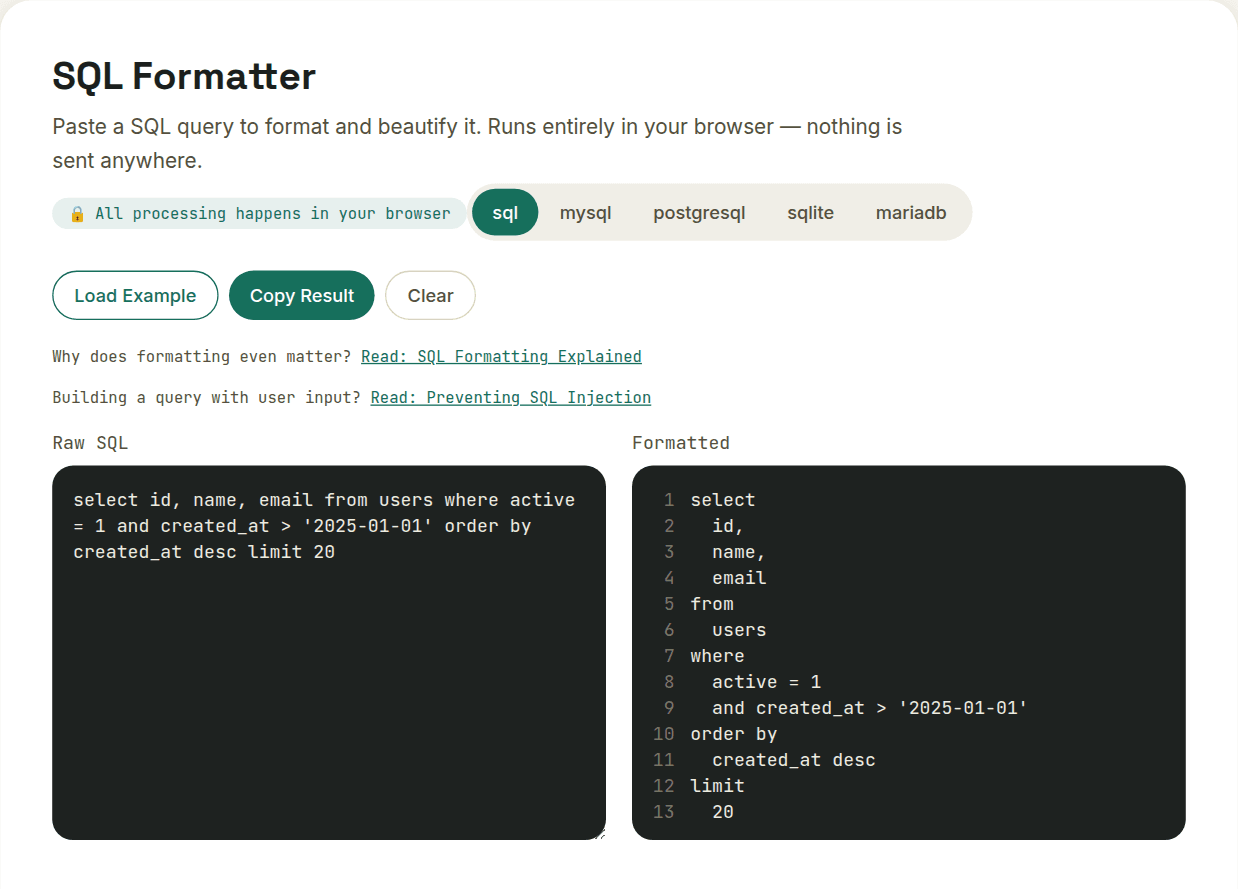
Readable SQL means each major clause (SELECT, FROM, JOIN, WHERE, ORDER BY) starts its own line, with columns and conditions indented underneath — a convention that costs nothing to apply and saves real debugging time the moment a query has more than one JOIN. Here's why that formatting habit is worth building, not just an aesthetic preference.
What unformatted SQL actually costs you
- Debugging time — finding which JOIN is producing duplicate rows in a 200-character single-line query takes real minutes; in a properly indented one, it's visible instantly
- Code review friction — reviewers skim formatted SQL in seconds; they have to mentally re-parse unformatted SQL line by line
- Bugs from missed clauses — a WHERE condition buried mid-line is far easier to overlook than one on its own indented line
What good formatting actually looks like
SELECT
  u.id,
  u.name,
  u.email
FROM users u
JOIN orders o ON o.user_id = u.id
WHERE u.active = 1
  AND o.created_at > '2025-01-01'
ORDER BY o.created_at DESC
LIMIT 20;
Notice the pattern: each clause (SELECT, FROM, JOIN, WHERE, ORDER BY) starts a new line. Selected columns are indented and stacked when there are more than one or two. Conditions in WHERE get their own line when there's more than one. None of this changes what the query does — it changes how fast a human can understand it.
Dialect differences are smaller than people think
MySQL, PostgreSQL, SQLite, and standard SQL differ in some function names and specific syntax (LIMIT vs. TOP, string concatenation operators, date functions), but the formatting conventions — indentation, clause breaks, capitalization of keywords — are essentially universal across all of them. Learning to format well in one dialect transfers directly to the others.
The fastest way to build the habit is to stop hand-formatting and let a formatter enforce consistency automatically — paste in a messy query, get back something you'd actually want to review.
Want to try this yourself?
Open SQL Formatter →