July 10, 2026
JSON vs. XML vs. CSV: Which Data Format Should You Use?
JSON is the best default for APIs and nested application data, CSV wins for flat tabular data and spreadsheet compatibility, and XML is worth reaching for when you need strict schema validation or are integrating with a legacy or SOAP system. The right choice comes down to whether your data is flat or nested, and whether the system you're talking to already dictates the format.
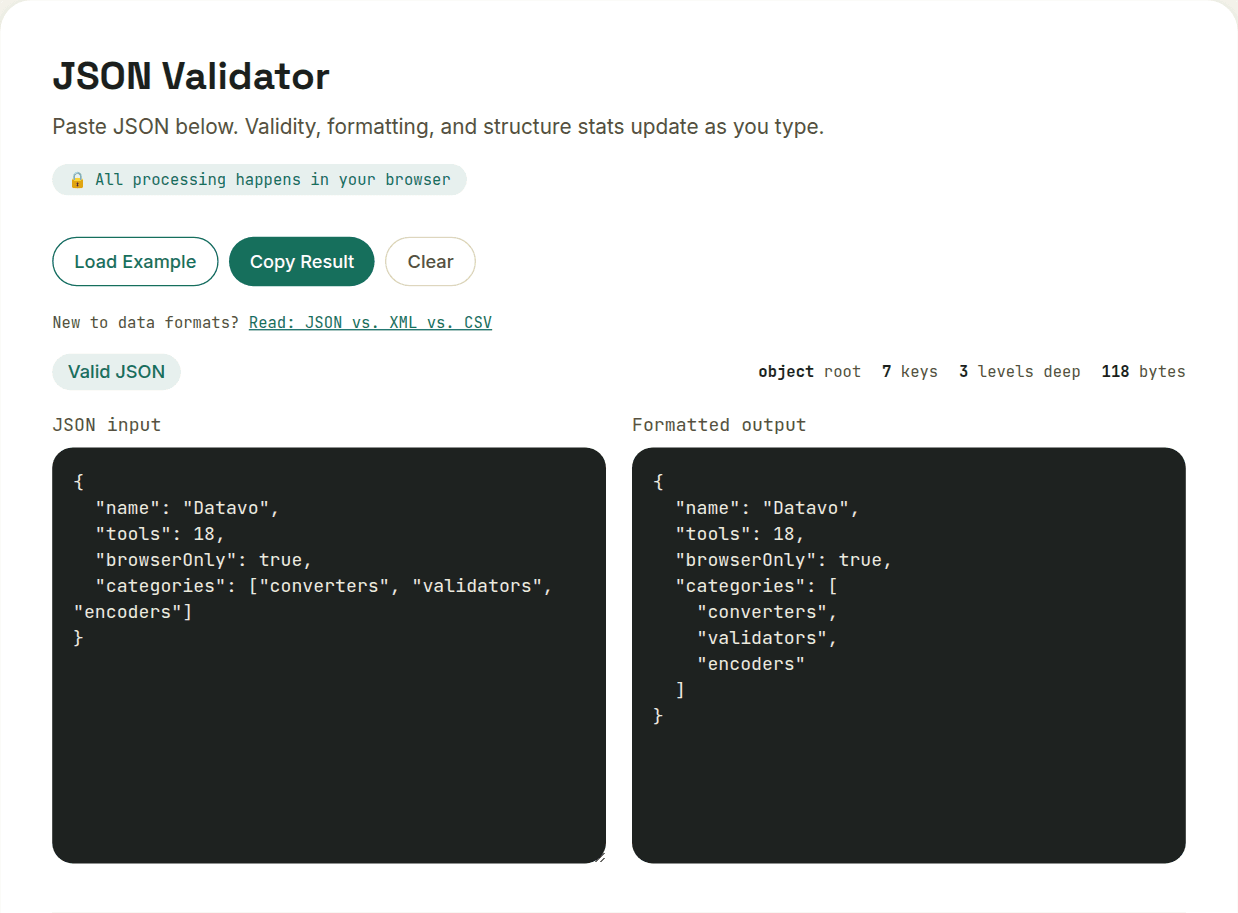
JSON: the default for APIs and config
JSON (JavaScript Object Notation) won the API format wars for good reason: it maps directly onto how most programming languages represent data in memory — objects, arrays, strings, numbers, booleans. It's readable, nests naturally, and every modern language parses it natively.
- Best for: REST APIs, config files, nested/hierarchical data, anything a JavaScript app will consume directly
- Weak point: not great for large tabular datasets — a 100,000-row JSON array of flat objects is needlessly verbose compared to CSV
CSV: the default for tabular data
Comma-Separated Values is the oldest format here, and it's still unbeaten for one thing: flat, tabular data that a human wants to open in a spreadsheet. It's compact, every spreadsheet tool reads it natively, and there's no nesting to worry about — which is also its main limitation.
- Best for: spreadsheet exports/imports, flat records (one row = one entity, no nested objects), large datasets where file size matters
- Weak point: no native support for nested data — you either flatten it (losing structure) or stringify it into a cell (losing queryability)
XML: the default for strict, validated, document-like data
XML is more verbose than either JSON or CSV, but it has something neither of them offer out of the box: strict schema validation (via XSD or DTD), namespaces, and a document-oriented structure that's genuinely better for content with mixed text and structure — think a formatted invoice or a legal document, not just a data record.
- Best for: enterprise systems with strict schema requirements (finance, healthcare, government), document-style content, SOAP APIs
- Weak point: verbose, slower to parse than JSON, increasingly less common for new API design
The practical answer
For new projects: default to JSON unless you have a specific reason not to. Use CSV the moment your data is genuinely flat and tabular and you want spreadsheet compatibility. Reach for XML only if you're integrating with an existing system that requires it, or you specifically need schema validation. Most real-world work involves converting between all three at some point — that's the whole reason format converters exist.
Want to try this yourself?
Open JSON Validator →